Thursday, January 24, 2008

Loved to Death

Halfway between San Francisco and Hawaii, a mother scours a mass of garbage twice the size of the state of Texas for treats to take home to her child. A bright yellow Lego block catches her attention. She scoops up the toy and heads back to its home.

When the baby sees her coming, it begins to whistle and click. She leans over the side of her baby’s crib. It opens its mouth and cries to show her it is hungry. She feeds the plastic toy to her baby, followed by a treasure trove of tangled fishing line, a red bottle cap, and fingers torn from a broken doll.

****

Nearly half of all albatross chicks die each year from dehydration and starvation. Most of these chicks are well-fed. Their stomachs are filled with twice as much plastic as the stomachs of chicks that die from other causes.

~The albatross is the largest of all the seabirds.
~Its wingspan can reach 11 feet.
~These birds spend about 85% of their time at sea, eating fish and sleeping on the water.
~They drink seawater.
~Between chicks dying from dehydration and starvation (caused by ingesting plastic?) and adults drowning at the end of fish hooks, the population of some species have decreased by as much as 90%, many have declined by 40-50%.

We saw many of these beautiful birds as we crossed the Drake Passage and in the waters around the Antarctic Peninsula. What a tragic loss to our own children if we lose these birds. I cannot help but ask myself how long it will be before we see that we are endangering our own loved ones as well—we are simply farther back in the line.

I am not fool enough to think that I or anyone else can bring the sum of our bad habits to a grinding halt. We’re like a train; it takes us a while to stop. My hope is that we can make a big difference through small changes. It is a place to start.

Friday, January 18, 2008

The Sky for a Bag of Gold

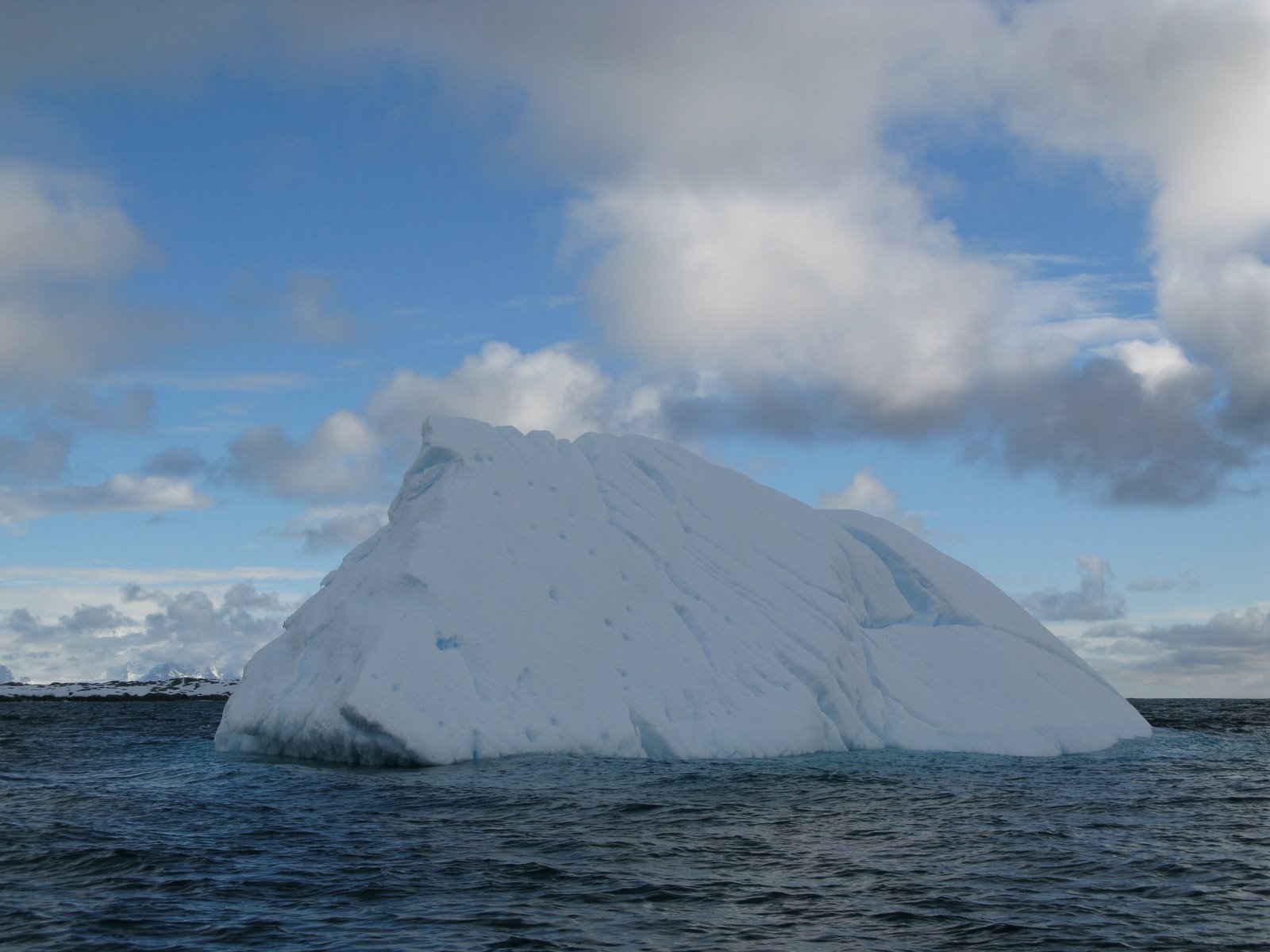
The ship rocks beneath my feet, as unnoticed as the beating of my heart. The ice stretches out between our ship and the cliffs rising in the distance, and I understand the power of the ice, the fragility of life. Land I can see, but not reach. Not even our powerful ship cannot breach that ice. We know this. We try, of course we try. Is that not the nature of humanity?

Silently my heart breaks with the ice. Why can we leave nothing as we find it? I wonder if the penguins perched on the edge of the ice will have to swim farther now to find food and then to return to safety. By our actions, have we killed another adéile or given a chance at life to a leopard seal?

The ice doesn’t care if penguins die, if seals live, if we reached our destination or not. It doesn’t care if we stay and wait, or leave. The earth doesn’t judge or forgive, she accepts.

I am ashamed for my people.

We charge the unbroken white, the only protests the creaking of our ship and the groan strangled in my throat. The ice halts our progress. The sun beats down, an ally to our cause, but even the sun cannot win our way. Not that day. But give her time. We turn and seek another path.

As we burn ozone in exchange for extravagant lives and trade gold for atmosphere, the sun gains power, the earth shudders, the ice weakens. Will our ally become our enemy? Will nature ever protest at how we impinge on her good will?

She lovingly gives in to our indulgences. She changes for us. She will change for us until we can no longer live and breathe her acceptance and her patience. Will she cry for us? Why should she? Having given us everything we asked, what has the earth to regret? What have we to regret but that we trade the sky for a bag of gold?

Saturday, January 12, 2008

Learning to See More

When I think of barren lands, barren wombs, barren lives, the image that comes into my mind is Seymour Island on the Weddell Sea side of the Antarctic Peninsula. Nothing grows here. I suppose a bit of lichen must cling to the sunny side of some wet rock, but I can’t find anything that isn’t brown or white. Even the mummified seal, however mystical, lacks color. The only things that move of their own volition are the wind, the birds in the sky, and the penguins.

The mummified seal suggests that the occasional pinniped also hauls out onto the ice that borders this desolate place. How is it then, in the absence of life, that life becomes so much more vibrant and real? I venture to guess it is because there is nothing standing between me and the beating of my heart.

No trees bar my view of the hilltops. None stand between me and the sea. Until the wind draws a curtain of cloud and snow across the horizon, I can see the bow-legged edge of water and sky. In the blue-green water, boulders shimmer, and I can believe them to be the petrified eggs of dinosaurs. In my pack I carry a collection of sharks' teeth set aside for further examination by the paleontologists. Sixty-five million years ago sharks swam where I stand. Then the weather changed, the sharks retreated. Time passed. Twenty-five or thirty million years later giant penguins—6 feet tall—lumbered across this land. I hold their bones in my hand, close my eyes, and listen.

Nothing lasts. The earth is patient. Why am I in such a hurry? What is missing in this sun, this blue-green water, these friends? What better thing will I find tomorrow or in ten thousand years?

Sunday, January 6, 2008

Memories of Water and Ice


I have been back from my Antarctica trip for almost a week now. First of all, I'm sorry it has taken me so long to acknowledge my return. Second, thank you for all your comments, notes, and well wishes. Knowing you were here to return to was a comfort.

Friends and family ask me what I saw and did. I open my mouth, but am not able to respond. Memories flash like whirlwinds across my mind's eye. I have a hundred answers and so am not able to articulate even one. I can talk for hours or days, but not for just a few minutes. I fear that if I begin to talk about this experience, I might never stop.

Perhaps this is a better place, a better way to unleash, and I have the 18 day cruise aboard the Laurence M Gould to account for. I stepped on the ship wary of spending so many days at sea. I said goodbye to my companions with tears in my eyes. This sentiment hints at the answer to what had the most impact on me during my travels--the people I met. But they deserve more than just an acknowledgment and, though I won't be able to get to them all, I will post profiles and excerpts from our conversations.

I had a wonderful journey, filled with new insights and a great deal of fun. It is sad to be gone from such a wonderful place and the people I met there, but good to be home. I have memories to last a lifetime--and as many pictures.

Again, thanks to you all for your support.

Tuesday, December 4, 2007

Setting Sail Today

As I prepare to leave Palmer, I find that I have more questions than before I arrived. I am overflowing with fresh perspectives and new ideas. The fluttering in my stomach suggests that I have been changed by these people and this place.

Looking back, I am embarrassed by my ignorance. Even those parts of my not knowing that have been erased by this journey still cause me shame. I thought it would be colder on this most southern continent. I thought this would be a black and white world, not one infused with brilliant blue-green or patched with rich shades of orange and yellow. I thought we had plenty of time to fix the hurt we are inflicting on the earth. I did not think I would miss the stars. I did not know I would be pierced to the core of my being by the sharp cries of the glacier dying.

Whether I am walking the coast, or sitting by a window and writing, or boating to one of the islands, I hear the glacier crying. She breathes the burning air, and her lungs collapse. She groans. She turns her face to the sun and loses clumps of hair to the fire. She presses into the earth, sloughing skin in giant handfuls. She screams. I fear her passing. Tears brighten my eyes.

I have come too close, sounds of the glacier dying will echo forever inside my head. I touched her. I cannot pull away—the palms of my hands are frozen to her skin.

My soul stepped onto the peninsula sleepy and complacent, it leaves wounded and afraid, but fear makes me stronger. And while I know the earth has plenty of time to heal, the knowledge that my own people teeter on the edge of extinction scares me.

(Photograph courtesy of Dan Jennings)

Friday, November 30, 2007

Out the Window


Every day, first thing, I look out the window. Between opening my eyes, climbing out of bed, and lifting the window shade, I wonder, “What kind of beauty will I see?”


This morning, it’s a ship set in water as clear and calm as black diamonds. The sun, poised in a cloudless sky, lights up the glacier in brilliant white and blue. Bergy bits knock against the stones lining the shore. An elephant seal’s call echoes off the ice. A tern screeches. But these noises of nature are a part of the stillness, not separate from it. The air is fresh and crisp, odorless.


How long, once I leave here, before I shut the window in my mind that drinks in the beauty of the moment, the wonder of the world, the exquisiteness of being, the preciousness of family and friends?

Tuesday, November 27, 2007

Close Encounter

Announcing himself with a burst of spray, the humpback rises out of the water beside of our zodiac. Terns chatter overhead, the surf crashes the shore, the sea herself slips off the humpback’s glistening skin like a whispered caress.

Forty-five tons of muscle, body over 50-feet long, he arches and dives. The water around the zodiac swirls. He circles us, rises, sprays, lifts his back, and slides beneath the gently rocking waves.

“How close do you think he came?” someone says, voice low, eyes scanning the water.

Close enough to reach out and touch, I think. This idea is unsettling. I am suddenly aware of how small we are—four of us in a boat no wider than one whale fin.

“Here he comes again,” one of my companions shouts and points. He skims beneath the boat, and I imagine that I am reflected in his eye.

The humpback floats underneath our zodiac, white belly shimmering in the blue water. He stretches his fins as though he is measuring our little craft. I hang over the side of the boat. His slender fin extends well beyond the edge of the zodiac. His rippled chin is just beneath the bow of our boat. In my head I hear a song. A tear wells in my eye, but I cannot tell if it is because the song is joyful or sad. Perhaps this is just the feeling of being present in the moment, focused, in awe.

Again he emerges, but farther this time. When he arches his back, his tail rises. I wave.

I search for words to express my gratitude, some sound that he will know, but I have none. If I stay here long enough, I will end up not able to talk at all.

(Many thanks to Stacie Murray for allowing me to use her wonderful pictures.)